Home · Sights · The Palace of Fine Arts
The Palace of Fine Arts
Level
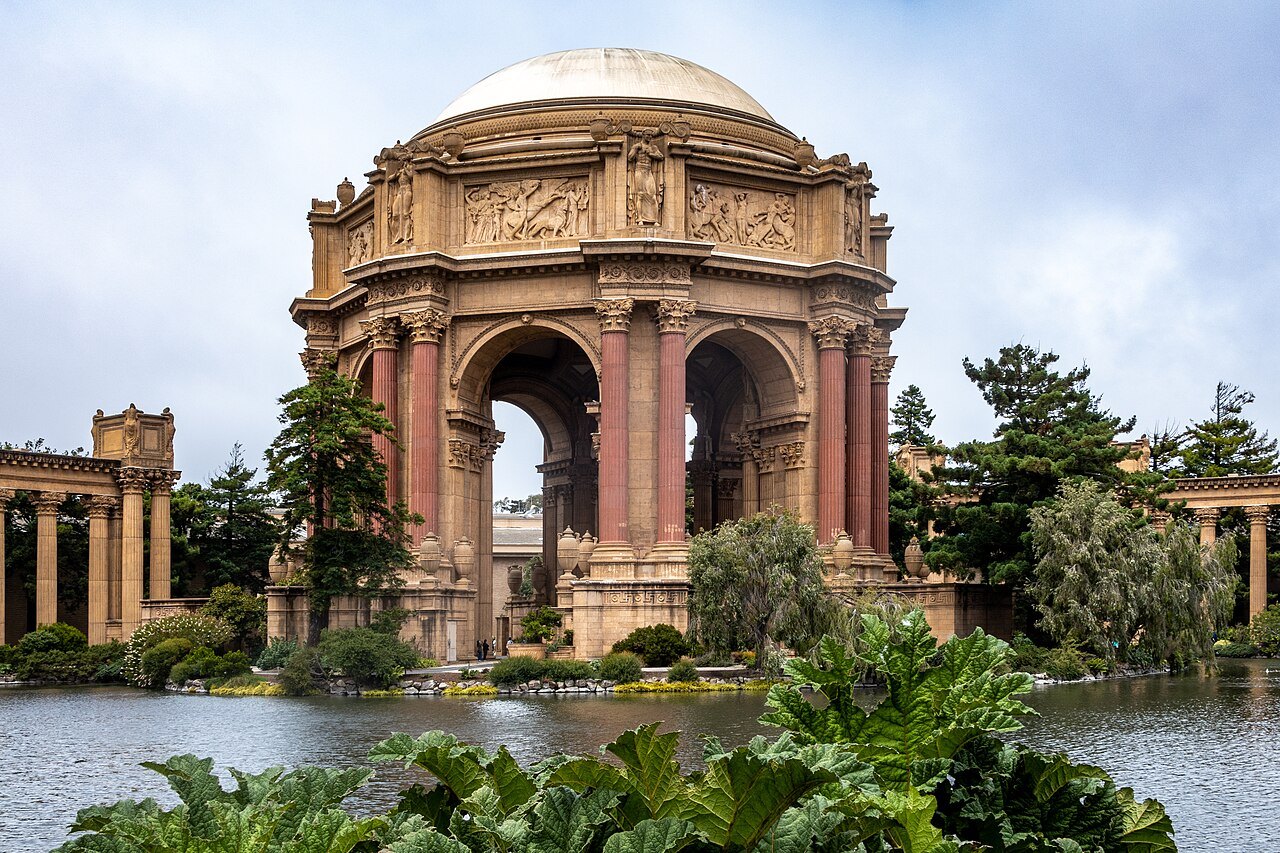
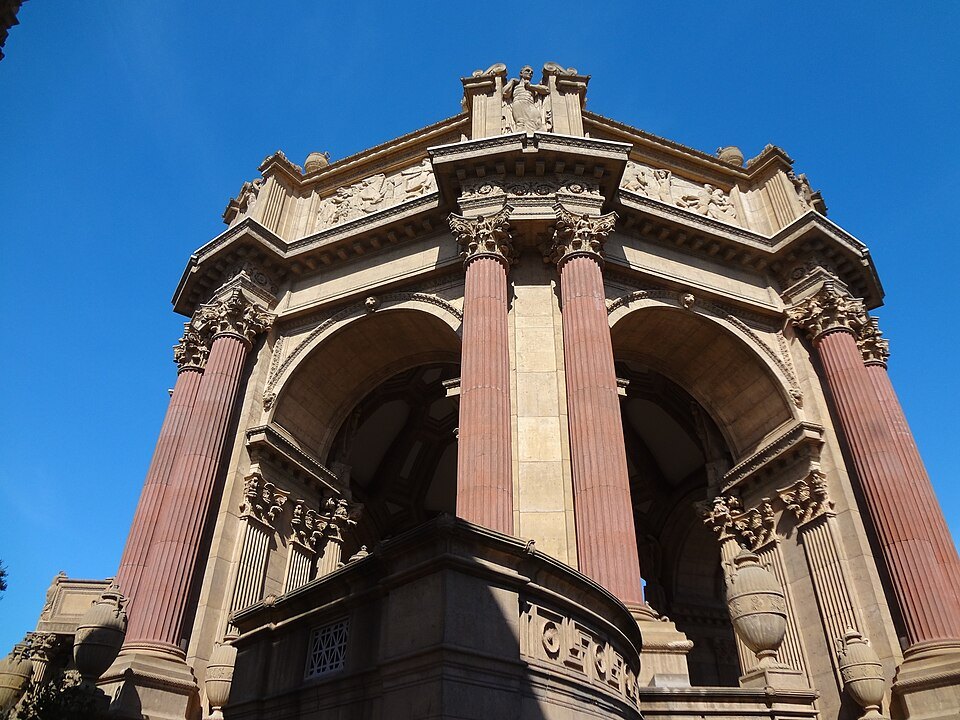
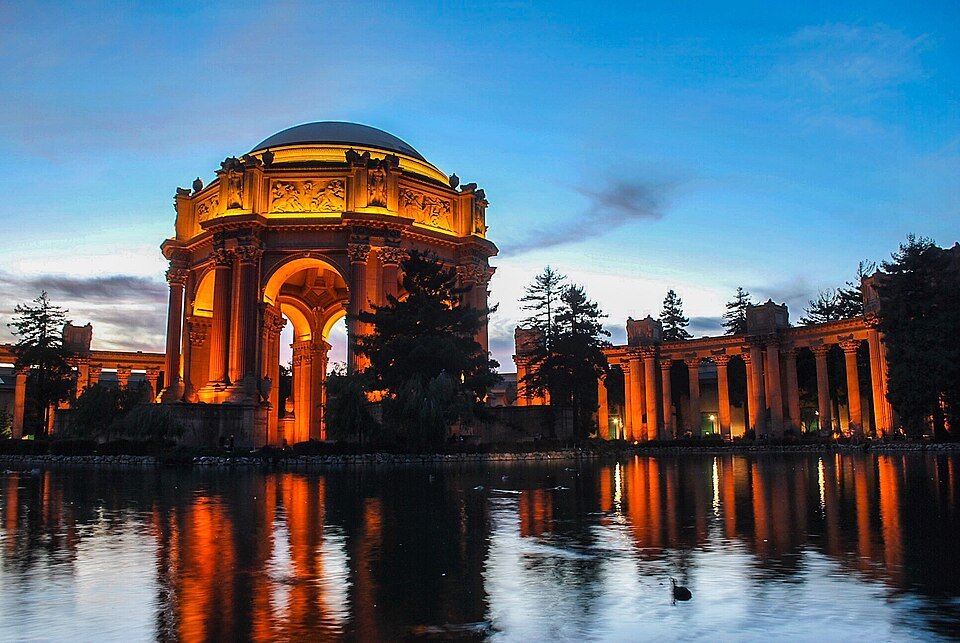
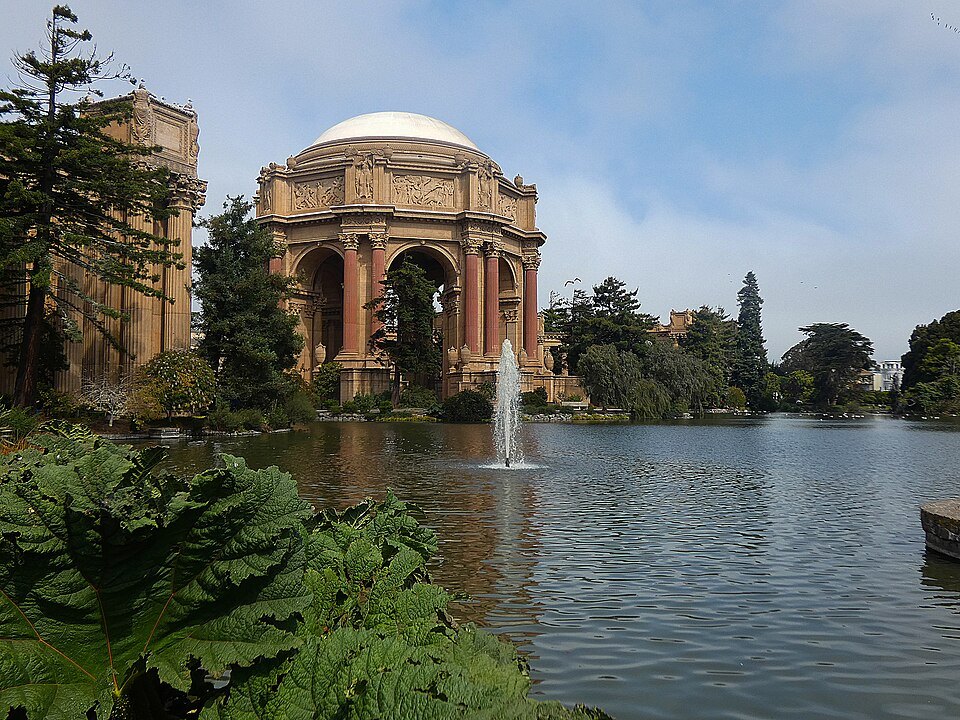
- 1The rotundaAn open domed rotunda 162 feet high, standing at the water's edge.
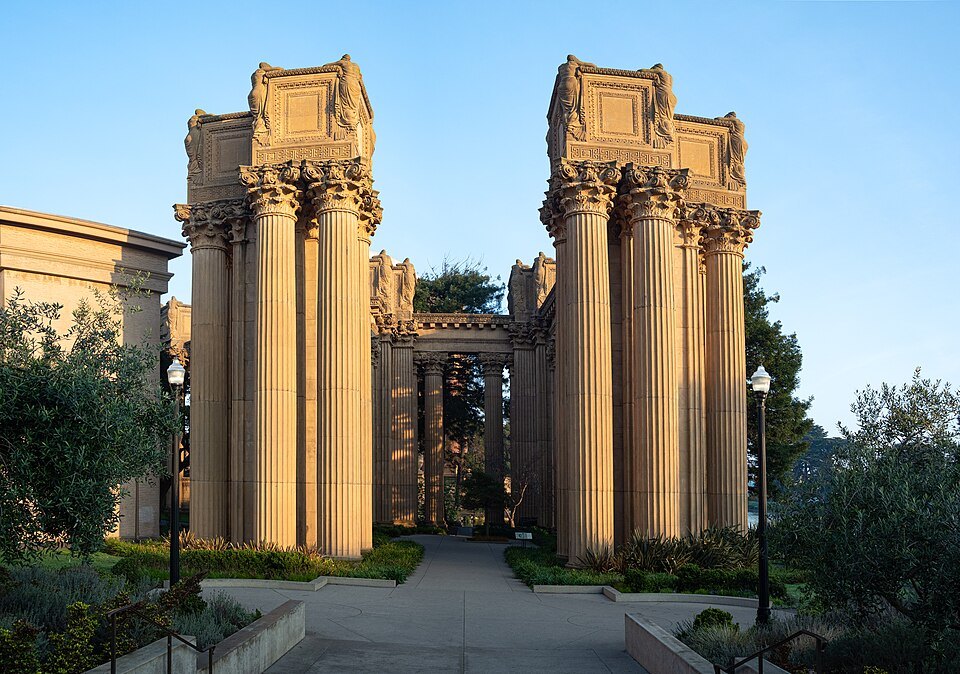
- 2The colonnadeA curving pergola of columns some 1,100 feet long, wrapping around the lagoon.
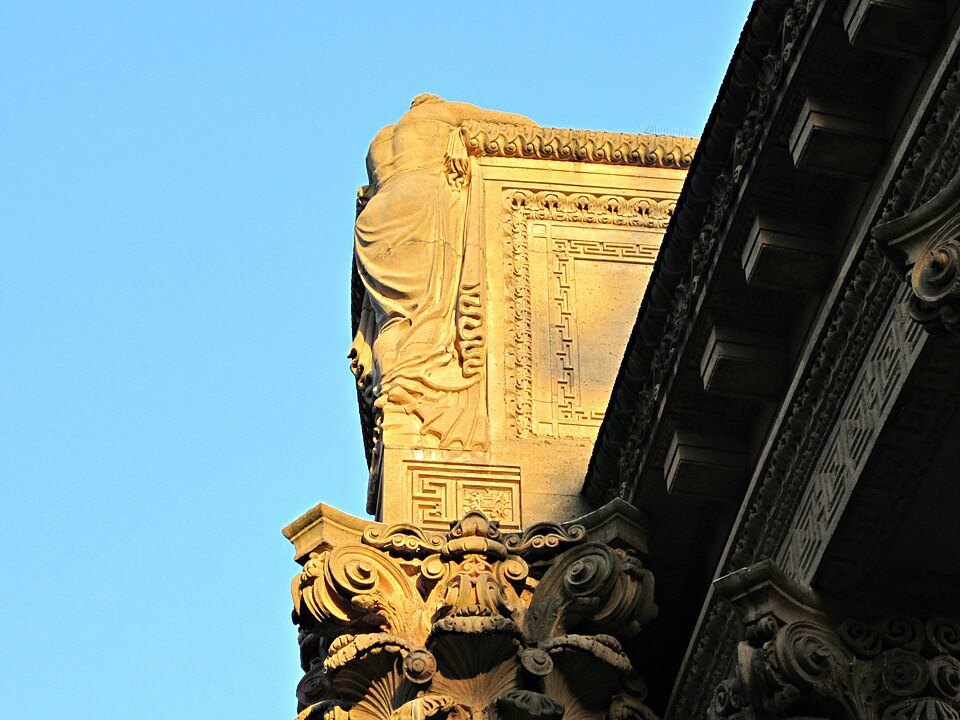
- 3The weeping womenFigures by Ulric Ellerhusen on top of the colonnade, faces turned to the planters, as if mourning.
- 4The lagoonA small artificial lake that mirrors the rotunda, in the European classical manner.
- 5The friezeBruno Zimm's panels around the rotunda, "The Struggle for the Beautiful".
- 6The exhibition hallThe long curved hall behind the colonnade, used for events and once home to the Exploratorium.
Reading the place
Why it matters
The Palace of Fine Arts is the one building of the 1915 Panama–Pacific International Exposition still standing on its site, and one of San Francisco's most recognizable landmarks: a pale, domed rotunda and a sweeping colonnade reflected in a lagoon on the northern edge of the city, just east of the Presidio. It is a favorite place for wedding photographs, for a quiet walk on a sunny afternoon, and for films; it has appeared in Hitchcock's Vertigo of 1958, in The Rock and in Bicentennial Man, among many others, and the headquarters Lucasfilm later built nearby in the Presidio has been noted for echoing it.
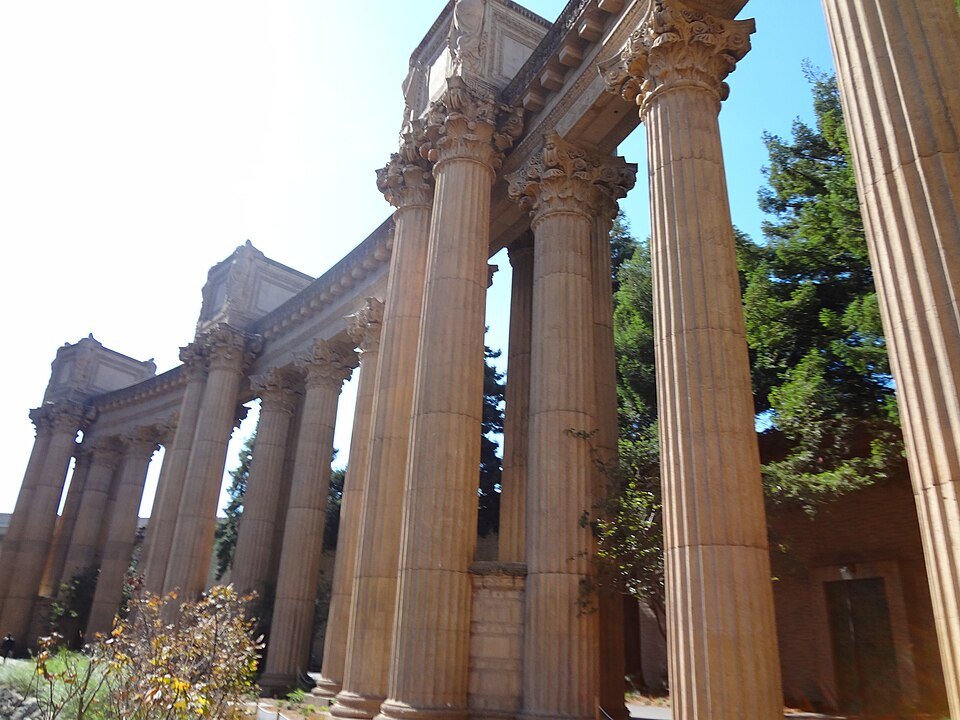
It is also a building with a strange double life. It was designed to look like a ruin, it began to become one in earnest, and it was then rebuilt, piece by piece, in permanent materials.
The fair of 1915
San Francisco held the Panama–Pacific International Exposition nine years after the 1906 earthquake and fire, to celebrate the opening of the Panama Canal and to show the world that the city had risen again. The fairgrounds covered 636 acres along the northern shore between the Presidio and Fort Mason, the land now called the Marina District, and held ten great exhibition palaces. Almost all of them were built of temporary materials and torn down when the fair closed.
The Palace of Fine Arts was designed by the architect Bernard Maybeck. He was asked for a building that would be a calm pause between the crowded fairgrounds and the galleries of paintings and sculpture behind it, and he designed, in effect, a fictional ruin from another time. He drew on Roman and Greek architecture, in particular Piranesi's etching of the remains of the so-called Temple of Minerva Medica in Rome, and on Arnold Böcklin's Symbolist painting Isle of the Dead.
Saved, and rebuilt
The Palace was so loved that a preservation league, founded by Phoebe Apperson Hearst, was formed while the fair was still running, and it was kept when the rest was cleared. But it had been built to last a year: its colonnade and rotunda were wood frames covered in staff, a mixture of plaster and burlap fiber. For a time it housed an art exhibition; in the Depression, WPA artists replaced its decayed dome murals; between 1934 and 1942 its hall held eighteen lighted tennis courts; in the war the army stored trucks and jeeps in it. By the 1950s the imitation ruin had become a real one.
In 1964 everything was demolished except the steel frame of the exhibit hall, and the Palace was rebuilt, until 1974, in lightweight poured concrete with a steel-framed dome, its decorations and sculptures cast anew. Only the dome murals and two end pylons of the colonnade were not replaced. A further restoration and seismic retrofit of the dome, rotunda, colonnades and lagoon was finished around 2010.
What you see
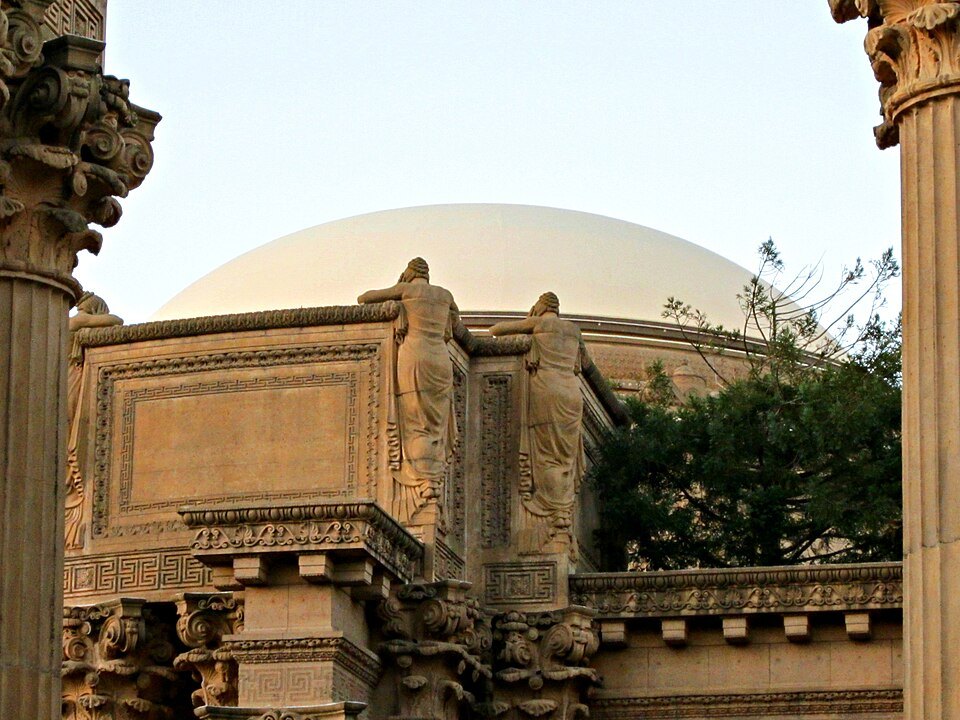
The rotunda is an open dome on columns, standing right at the water's edge, 162 feet high. Around its upper band run Bruno Zimm's relief panels, "The Struggle for the Beautiful", a tribute to Greek culture. On either side, the colonnade sweeps away in a curve some 1,100 feet long, a pergola of Corinthian columns. On top of the colonnade stand Ulric Ellerhusen's weeping women, figures facing inward toward the planter boxes, their faces hidden, as if mourning; with the lagoon and the overgrown planting around it, they give the whole place its melancholy.
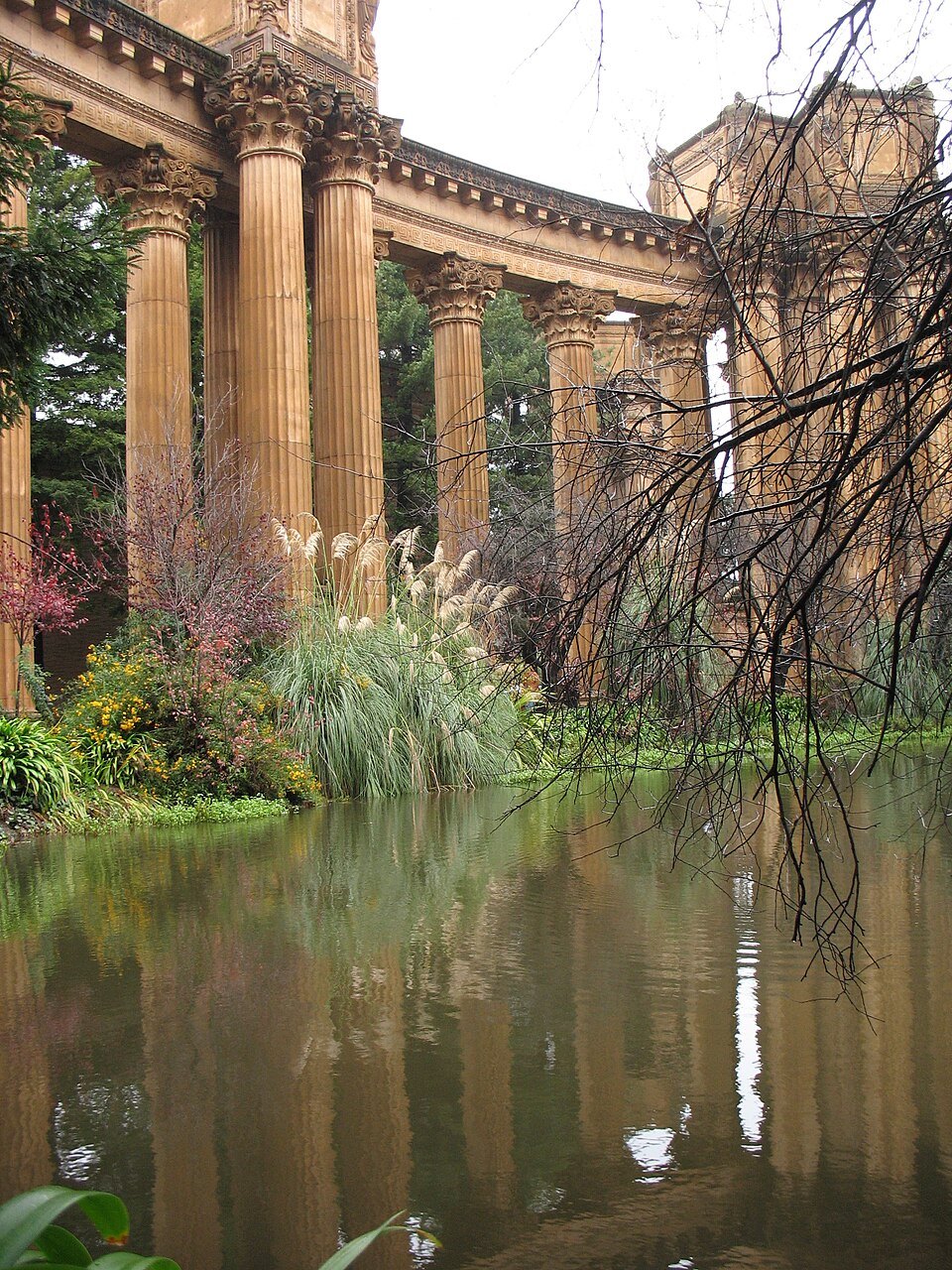
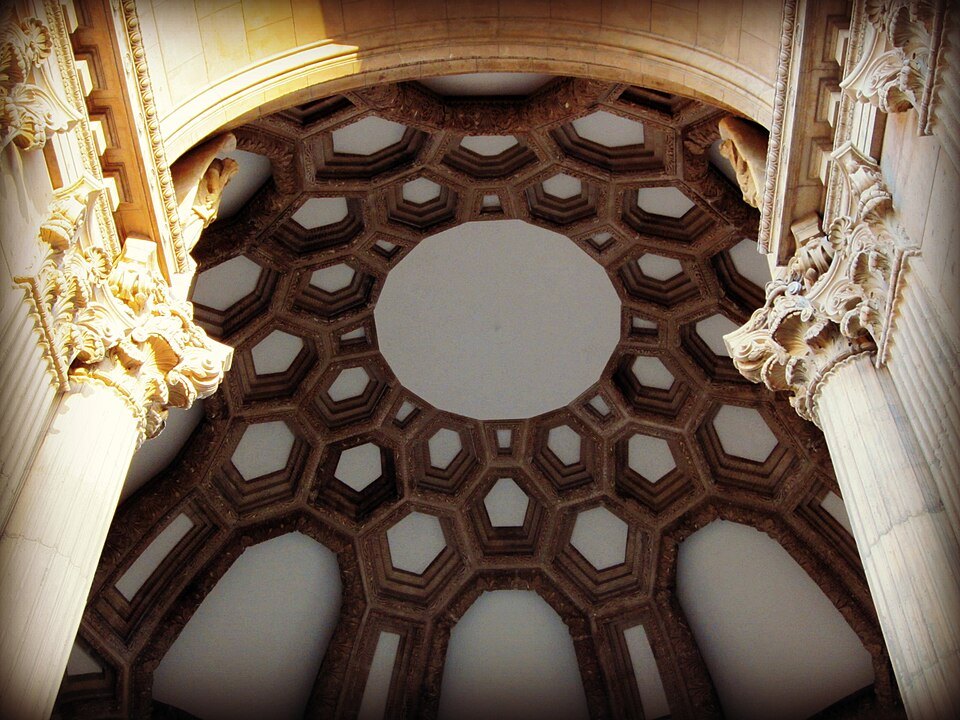
Across the lagoon you see the rotunda reflected whole, which is the point: the lagoon was meant to work as the still water of a classical European garden, a mirror that lets you take in the building from a distance. Look up inside the dome and you see eight large recessed panels. They once held murals by Robert Reid showing the birth of Art and the four "golds" of California, poppies, citrus fruit, metallic gold and wheat; those murals were not replaced in the rebuilding. Behind the colonnade, the long, curved exhibition hall, one of the largest single-story buildings in the city, housed the Exploratorium science museum from 1969 until 2013, and hosted a presidential debate between Gerald Ford and Jimmy Carter in 1976; today it is used for events.
How to visit
The Palace is at the eastern edge of the Presidio, close to the Marina District and Crissy Field, and the whole site is level and easy to walk. There is nothing to book and no ticket for the rotunda and lagoon; allow half an hour for a slow circuit of the lagoon, longer for photographs. It is at its finest on a clear, still morning, when the reflection is sharpest.
Several Muni bus lines run along the edge of the Marina close by; see getting around. It makes a natural pairing with a walk to Crissy Field and the Golden Gate Bridge, and with the Presidio on the far side of the road. Weddings and events often use the site, especially at weekends, so part of it may be busy.
Myths and facts
The Palace you see is not the one of 1915. It is a faithful reconstruction of the 1960s and 1970s in concrete, which is why it has outlasted its temporary original. And its ruinous look is not the work of time: Maybeck designed it to look like a ruin from the beginning, supposedly believing that every great city needs one.
Nearby
- NearbyThe Presidio and Crissy FieldThe Spanish fort of 1776 at the Golden Gate became an American army post and then, in 1994, a national park of forests, parade grounds and old barracks, with a restored marsh and beach at Crissy Field.Read the page
- NearbyThe Golden Gate Bridge and Fort PointA suspension bridge of 1937 across the mile-wide mouth of the Bay, painted International Orange, with an 1861 brick fort tucked under its southern arch.Read the page
- NearbyLombard Street and Russian HillA single block of brick-paved switchbacks on Russian Hill, built in 1922 to tame a 27 percent grade, set in one of the city's oldest and most elegant hilltop neighborhoods.Read the page