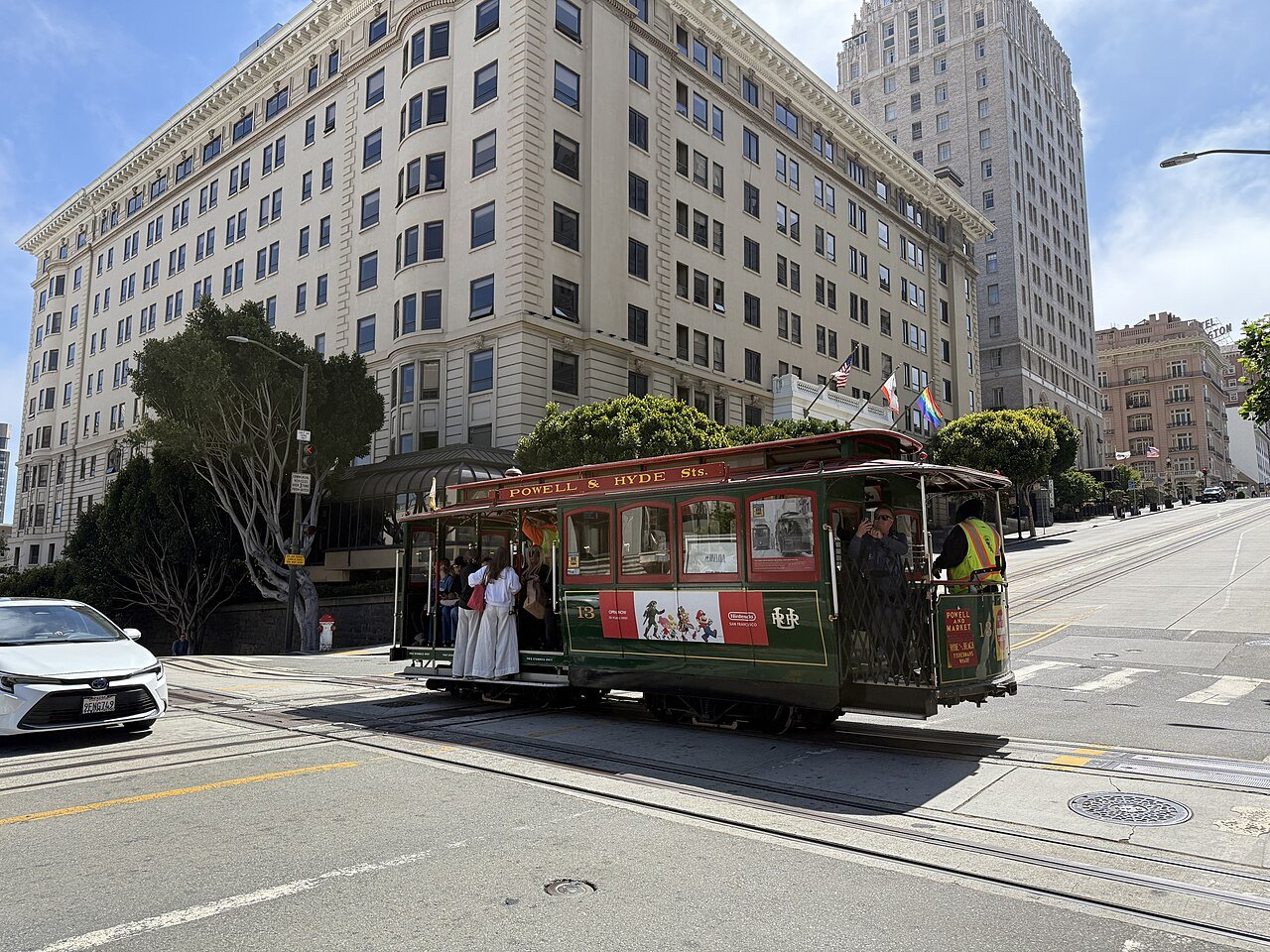
How do you ride the cable cars in San Francisco?
The three lines and where they go, where to board to skip the longest queue, how to pay before you ride, how to stand on the running board safely, and what to see at the Cable Car Museum.
Read on
The short answer
Choose your line, pay before you board, and hold on. Three lines survive. Two, the Powell–Hyde and Powell–Mason lines, start at the turntable at Powell and Market streets and climb over Nob Hill to the Fisherman's Wharf area; the third, the California Street line, runs from California and Market over Nob Hill to Van Ness Avenue. At the busy turntables you must buy your fare in advance during the day, most easily on the MuniMobile app or with a Clipper card.
The queue at Powell and Market can be long. You can also board at any stop along the route, marked by a brown-and-white cable car sign, or start from the other end of the line.
Why they still run
The cable car was invented here. Andrew Smith Hallidie promoted the first line, the Clay Street Hill Railroad, which began running in 1873, and his patents made him wealthy as the idea spread. By 1890 twenty-three lines crossed the city. Most were replaced by electric streetcars and buses, and in 1947 the city proposed to scrap the last of them, until a citizens' committee led by Friedel Klussmann forced a vote and saved them.
Today the system is the world's last manually operated cable car network, one of only two street railways named a National Historic Landmark, and a working part of the city's transit. The cars are not a ride built for visitors: they still carry people up hills too steep for most buses, the same way San Franciscans climbed them in the 1870s.
Which line to take
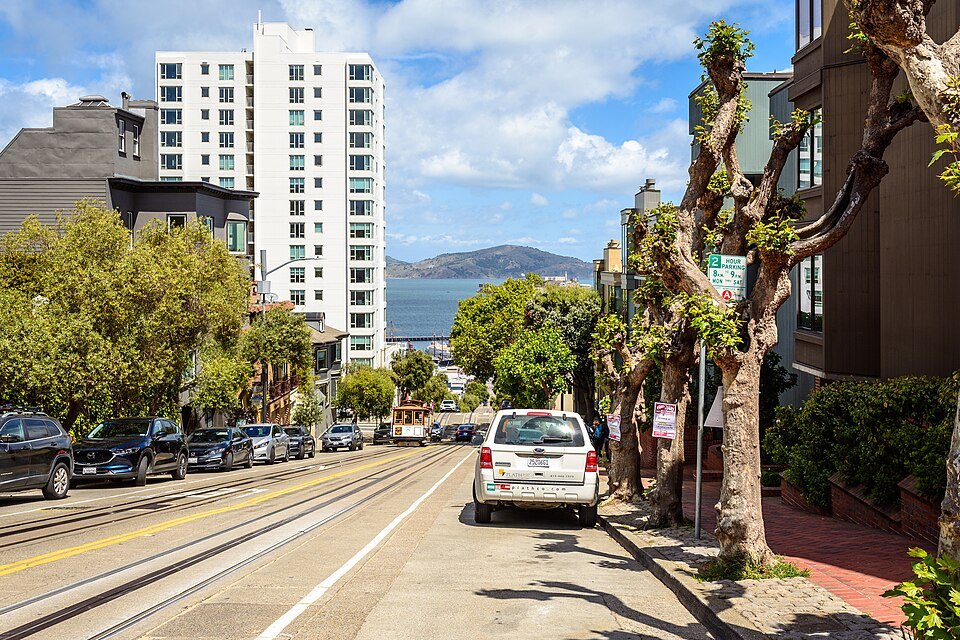
The Powell–Hyde line is the one with the famous views. From Powell and Market it climbs Nob Hill, crosses the California Street line at the summit, then runs over Russian Hill, past the top of Lombard Street, and drops steeply to the turntable at Hyde and Beach streets by Aquatic Park, with the bay and Alcatraz ahead of you.
The Powell–Mason line shares the first part of the route, then turns down Mason Street to Bay and Taylor, a few blocks from the Wharf and Pier 39. The California Street line runs east–west over Nob Hill, with double-ended cars that need no turntable, and is usually the least crowded of the three.
Paying for the ride
The transit agency asks riders boarding at the three busiest turntables, Powell and Market, Bay and Taylor, and Hyde and Beach, to buy their fare in advance during the daytime. The easiest way is MuniMobile, the agency's official ticketing app, which takes cards and phone payments. A Clipper card works too, as does a Muni visitor Passport, which covers every regular line, cable cars included, for one, three or seven days.
A single cable car fare does not include transfers, so if you plan several rides in a day, or want to combine the cable cars with the streetcars and buses, a Passport is usually the simpler choice; see booking ahead.
Where to stand, and how to hold on
There are three ways to ride: seated inside the enclosed section, seated in the open section, or standing on the running boards along the sides, holding one of the upright poles. Standing is the classic ride, but the agency's advice is clear: hold on tight, and do not lean outward while holding the poles, because the cars pass close to traffic and to each other on the hills.
When you get off, wait until the car comes to a complete stop, then check the street before you step down. The cars share the roads with ordinary traffic, and the green X signal at cable car intersections is for the cars, not for people crossing on foot.
How the cable works
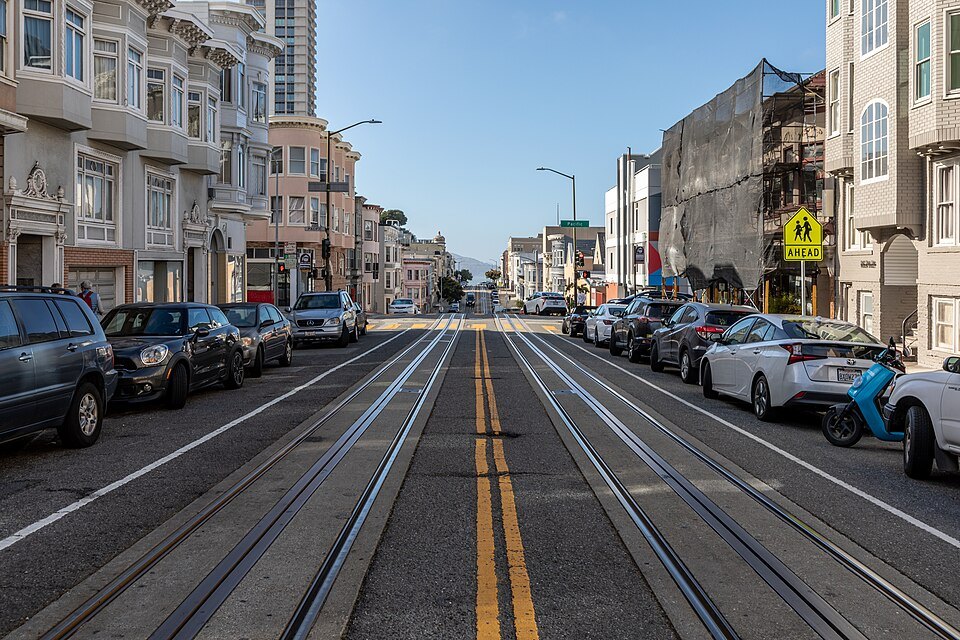
The cars have no engines. Beneath the slot in the middle of each track, a steel cable runs in a loop at a constant speed of about nine and a half miles an hour, driven from the powerhouse on Nob Hill. Each cable is made of six steel strands, each of nineteen wires, wound around a core of sisal rope that makes it easier to grip. To move, the car clamps on to the cable; to stop, it lets go and brakes.
That is why the ride has its particular rhythm: a steady pull uphill, a release and a coast at the crossings, and a clang of the bell as the car sets off again.
Who works the car
Each car has two crew. The grip operator, at the front of the Powell cars, works the grip, a lever that clamps on to the steel cable running under the street, and must know exactly where to let go to coast over crossing lines and curves. The grip's jaws press on the cable with up to thirty thousand pounds per square inch, and wear so fast that their dies are changed every few days.
The conductor collects fares, manages the crowding and works the rear brakes on some hills. Either will answer questions and tell you where to get off.
Who can ride
The cable cars are not equipped with accessible boarding: there are high steps and running boards, and no ramps or lifts. Anyone who uses a wheelchair or finds steps hard will do better on the F-line streetcars, the buses and Muni Metro; see getting around. Full-size and folding bicycles are not allowed aboard. Service animals are welcome, and the agency asks that they ride in the interior section, on a lap or out of the aisle.
The Cable Car Museum
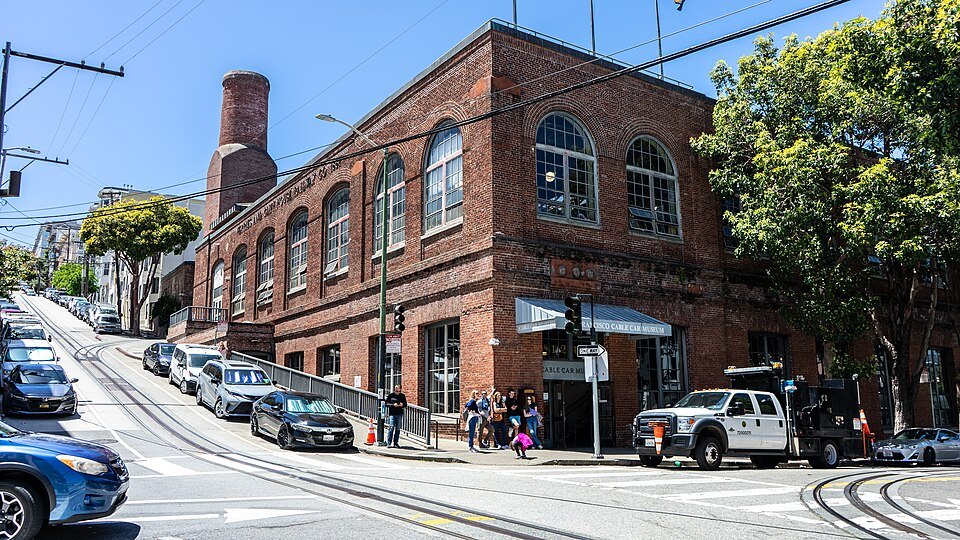
All the lines are pulled by cables driven from one building, the powerhouse and car barn at Washington and Mason streets on Nob Hill, built for the Ferries and Cliff House Railway and still in use. Inside it, the Cable Car Museum lets visitors watch the great winding wheels from a gallery above, and go down below the junction of Washington and Mason to the cavern where the haulage cables are turned by huge sheaves before they run out under the streets.
It is one of the best free sights in the city, and every Powell car passes within a block of it. See the cable cars for their full history.
More from the journal
- Getting HereHow do you get from SFO to downtown San Francisco?BART from the terminal to Market Street, the free AirTrain that links the gates to the station, how to pay, and when a taxi, ride-hail or Caltrain makes more sense.Read the piece
- When to ComeWhy is San Francisco so cold and foggy in summer?How the cold Pacific, the hot inland valleys and the gap of the Golden Gate make San Francisco's summer fog, why it comes and goes each day, where in the city it is thinnest, and how to plan around it.Read the piece
- The Golden Gate Bridge and Fort PointCan you walk across the Golden Gate Bridge?Yes, on the eastern walkway, which faces the city. Which walkway is for whom, how long the crossing is, where to start and finish, what to wear for the wind, and what to look for on the way.Read the piece