What do the murals inside Coit Tower show, and who painted them?
A guide to the Coit Tower lobby murals: their painters, subjects, the 1934 controversy, and how to see them today.
Read on
A pilot project of the New Deal
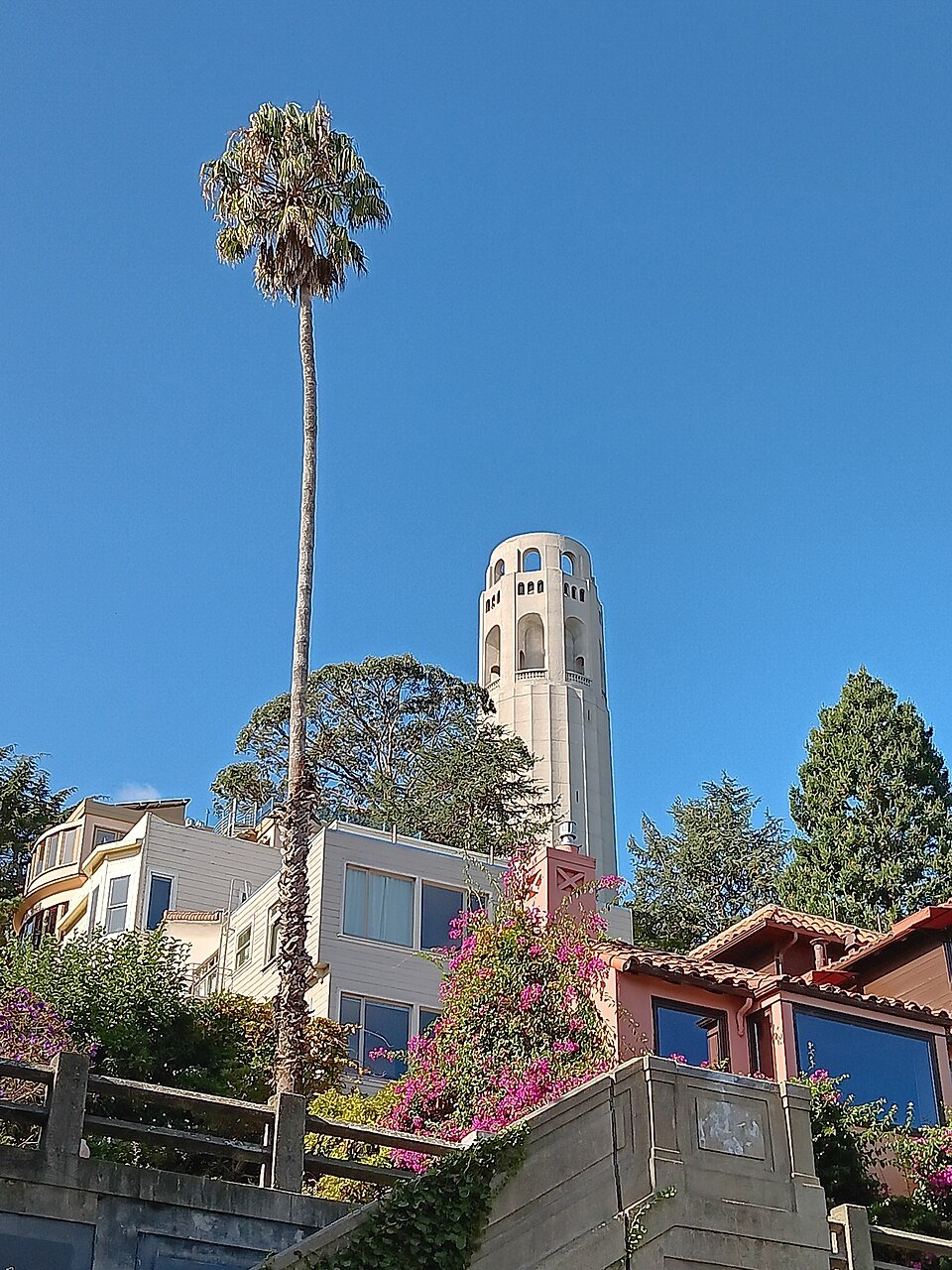
The murals that cover the lobby of Coit Tower were not an afterthought to the building. They were the pilot project of the Public Works of Art Project, the first of the New Deal programs created to pay artists to work during the Depression. Coit Tower had just been finished on Telegraph Hill, and its round ground-floor lobby, unbroken by furniture, gave the project a single continuous wall to fill.
Ralph Stackpole and Bernard Zakheim won the commission in 1933 and assembled a team of more than twenty artists to carry it out. Among them were Victor Arnautoff, Maxine Albro and John Langley Howard, working in a shared style known as American Social Realism, which set out to show ordinary working life rather than allegory or portraiture.
Most of the panels are true frescoes, meaning the pigment was applied into wet plaster so that it became part of the wall itself rather than sitting on top of it as paint would. That technique demanded speed, since each section had to be finished before the plaster dried. The murals have since been cleaned and touched up, most of them in 1990 and again in 2014.
Who painted what
The team divided the lobby into scenes, each artist taking a subject drawn from California life. Maxine Albro painted agricultural scenes of fields and orchards; other artists took up city streets, a newsstand, a public library and a busy waterfront, building a composite portrait of the state in the middle of the Depression rather than a single narrative.
Victor Arnautoff and John Langley Howard both painted industrial and urban scenes, factories and city crowds rendered in the same blunt, documentary manner as the agricultural panels beside them. The murals were meant to be read together as a walk around the room, so a visitor moving slowly along the wall passes from farm to factory to street to port in a single circuit.
Clifford Wight, a member of the same team, painted a smaller panel that would become the center of the project's one real crisis. The list of contributors ran to more than twenty names in total, making the lobby one of the largest group efforts of the whole New Deal art program and a rare case of that many muralists working on one interior at once.
Controversy and a hidden panel
The murals were controversial from the moment they were finished. In 1934, with a waterfront strike under way at the foot of the hill, officials and local newspapers accused several of the artists of slipping communist propaganda into their work, seizing on two details in particular.
One was the banner of a communist newspaper worked into John Langley Howard's industrial scene; the other was a hammer and sickle in Clifford Wight's small panel. Both details were painted over before the tower opened, a compromise that let the rest of the cycle stand but left two altered patches in an otherwise unedited set of walls.
The tower finally opened to the public on October 12, 1934, well after the building itself was complete, the delay a measure of how seriously the dispute was taken. The episode is a reminder that the murals were never simply decorative; they were made at a tense moment in the city's labor history and read, at the time, as a real political statement.
What survives to see
The city's own voters made a formal commitment to their upkeep. In 2012 they passed a measure requiring the city to pay for the murals' preservation, which means the paintings are treated as civic property to be maintained rather than left to decay quietly on a public wall.
Inside the rotunda today the murals wrap around the walls at eye level, close enough to study individual faces, shop signs and the small printed details, communist banner and hammer-and-sickle aside, that made up the artists' picture of nineteen-thirties California. The scale is intimate rather than monumental, closer to a corridor of paintings than a grand hall.
The two altered details are part of the story now as much as the rest of the cycle, evidence of a fight over what public art was allowed to say in the middle of the Depression. Knowing the history changes how the room reads: the newsstands, the library and the crowds of workers were painted at a tense moment, and the argument over them decided what the public would finally see.
Seeing the murals on a visit
The lobby murals can be seen without going to the top of the tower, so a visitor short on time or unwilling to climb can still take in the whole cycle at ground level. Plan an hour or more if the visit also includes the viewing deck and the surrounding park, since the murals alone are only one part of a stop at Coit Tower.
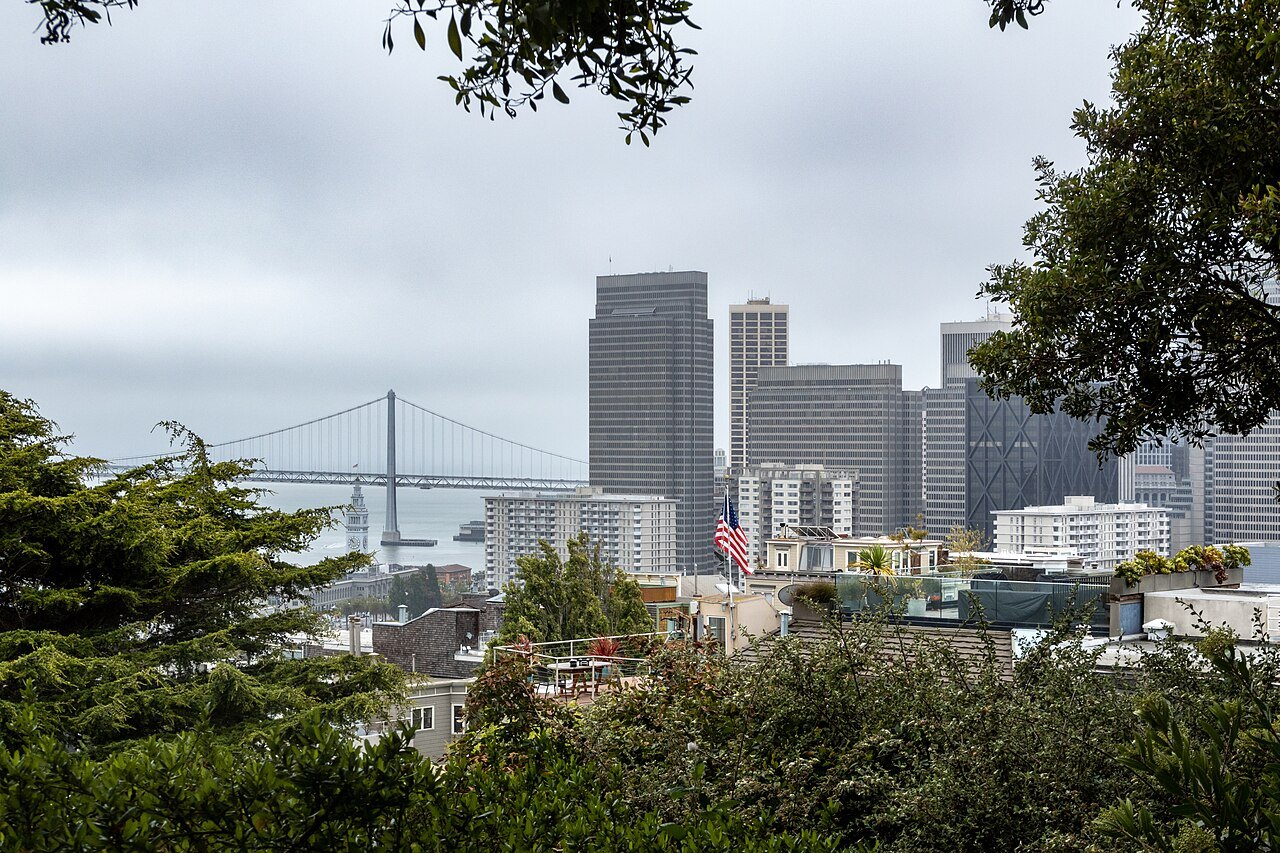
The tower's elevator carries visitors up toward the open viewing deck near the summit, where arched openings frame the Bay Bridge and the Financial District to the south and Alcatraz and the Golden Gate to the north and west, a separate experience from the murals below. Anyone who needs step-free access all the way up should check the tower's own information before setting out.
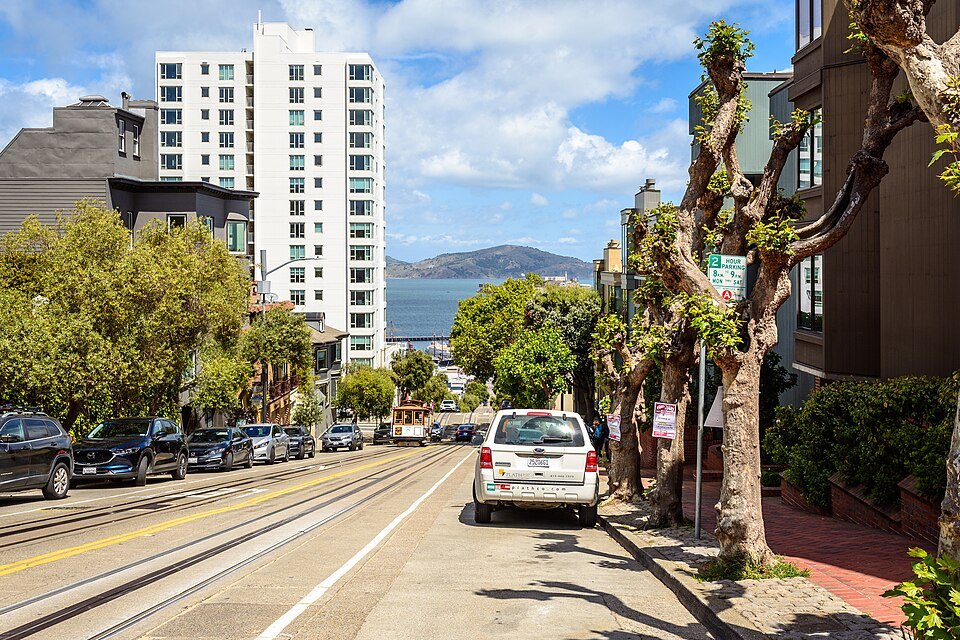
The hill itself is steep from every side, so getting to the tower is part of the effort of seeing the murals. From North Beach and Washington Square it is a stiff uphill walk of several blocks, and Muni's 39 Coit bus climbs from the flats below for those who prefer not to walk it; see The Hills for more on the gradients around Telegraph Hill.
Combining the visit
The small parking circle at the summit is often full, so visitors arriving by car should expect to leave it below and walk up, or take the bus instead. The Filbert Steps, about four hundred wooden steps down the eastern side of the hill, are a scenic way to descend toward the Embarcadero afterward, through the Grace Marchant Garden and past houses reachable only on foot.
Coit Tower sits naturally at one end of a longer walk through this part of the city. The homepage walk strings it together with Chinatown and North Beach, and the Chinatown and Where to Stay pages give more on those areas if the murals are only the first stop of the afternoon.
For visitors weighing the tower against other stops in the city, The Sights sets it in the wider context of San Francisco's landmarks, and Getting Around covers the buses and cable cars that connect Telegraph Hill to the rest of downtown.
More from the journal
- The SightsWhat survives of the 1906 earthquake in San Francisco?The earthquake and fire of April 1906 destroyed most of the city. Here is what came through, what was rebuilt in its place, and where you can still see the traces, from Mission Dolores to the Portals of the Past.Read the piece
- The Cable CarsHow do you ride the cable cars in San Francisco?The three lines and where they go, where to board to skip the longest queue, how to pay before you ride, how to stand on the running board safely, and what to see at the Cable Car Museum.Read the piece
- The Golden Gate Bridge and Fort PointCan you walk across the Golden Gate Bridge?Yes, on the eastern walkway, which faces the city. Which walkway is for whom, how long the crossing is, where to start and finish, what to wear for the wind, and what to look for on the way.Read the piece